
Escrow Analysis FAQ


Understanding Your Escrow Statement

An escrow account helps pay property taxes, homeowners insurance, and/or mortgage insurance (if applicable). Each year, GreenState reviews your escrow account to compare the amount deposited with the actual costs paid and projected future expenses. 

If costs increase, your account may have a shortage and your payment could increase. If costs decrease, you may have a surplus that could lower your payment or result in a refund.


Updating Your Recurring Payments

If you have a change in your monthly payment, you will need to update your recurring payments to reflect the new amount in the following scenarios:

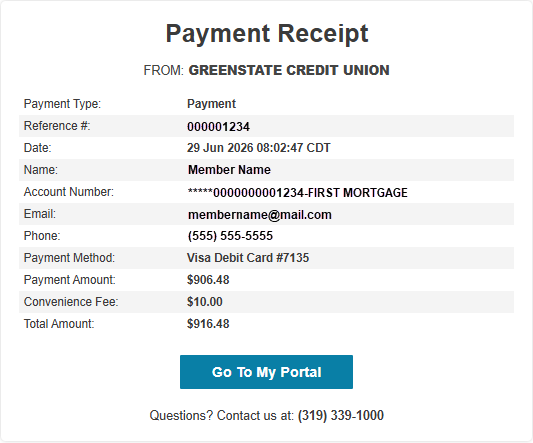
  1. You set up your monthly payment in the Online Payment Center. Instructions on how to update your payment in the Online Payment Center can be found here. An example of an Online Payment Center receipt can be found here.
  2. You set up a recurring transfer within Online Banking. Instructions on how to update your payment in the Online Payment Center can be found here.
  3. Your payment was set up at another financial institution (such as a bill-paying service)

You will not need to update your payments if your payment was set up with the help of a GreenState staff member or directly through the Mortgage Loan portal. 


How Your Payment is Calculated

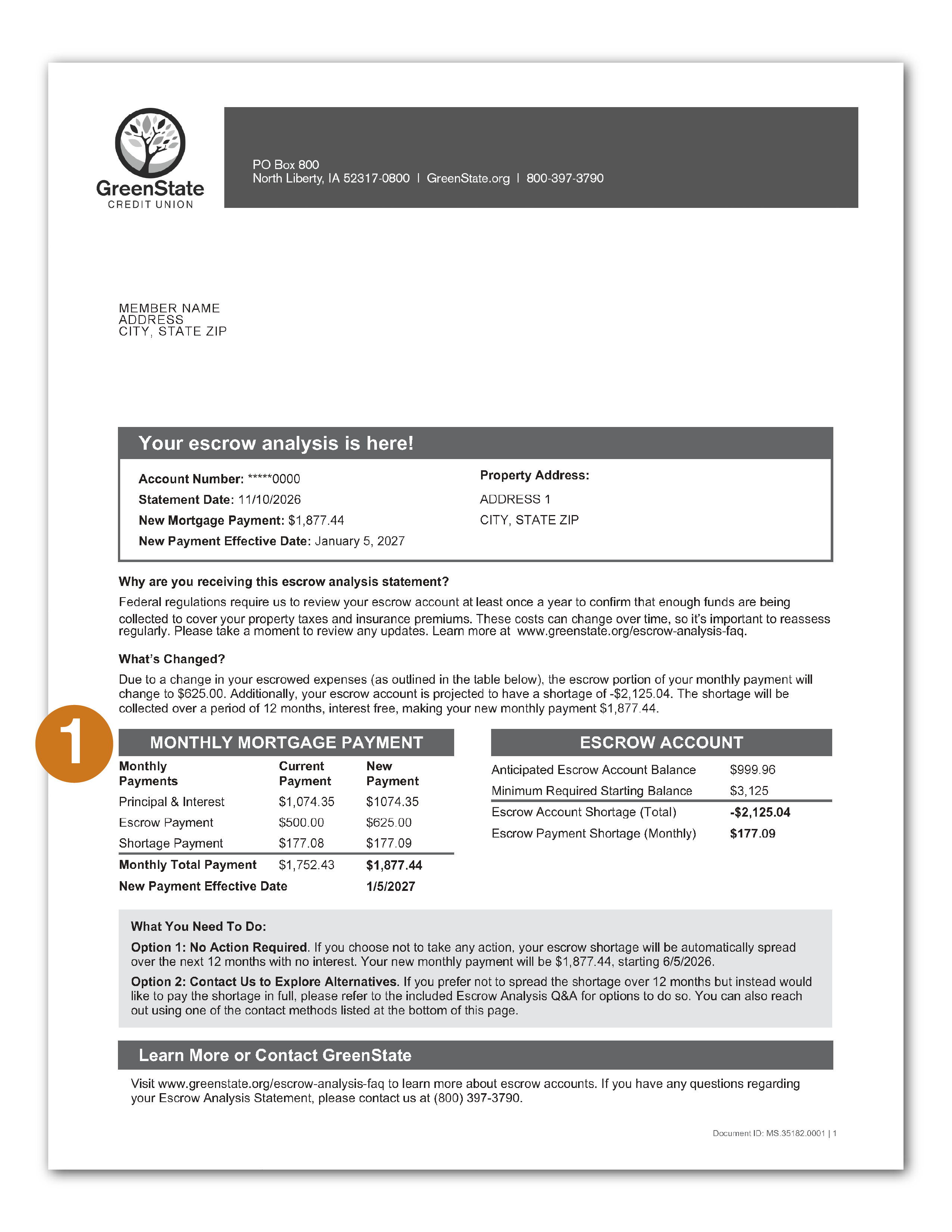
Click through pages 1, 2, and 3 of the example statement below for additional information.

Page one of your statement provides information about your Monthly Mortgage Payment and Escrow Account (1). It outlines your current mortgage payment, new mortgage payment, and shows if there is a shortage or surplus in your escrow account.
Escrow Example Page 1 updated

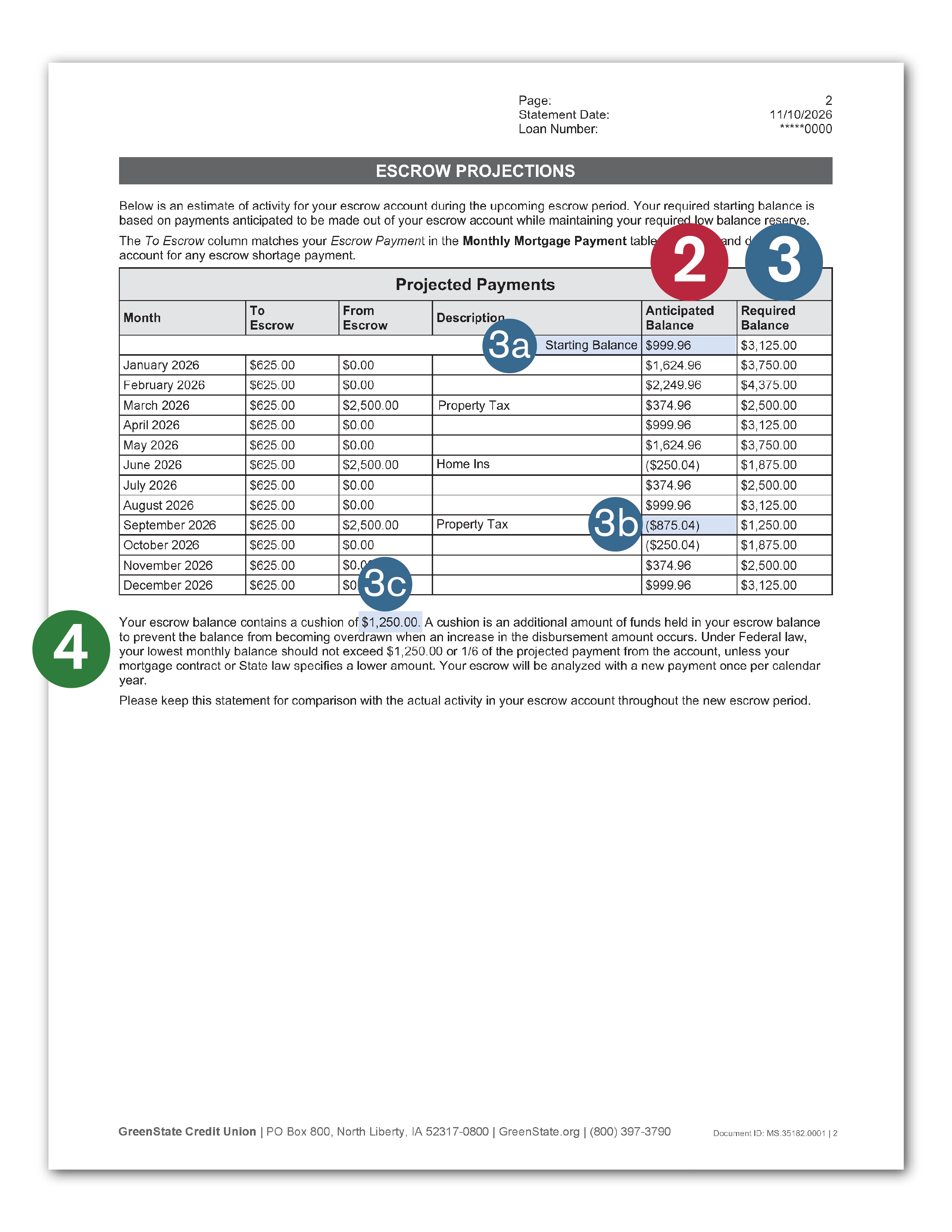
Page two shows the Escrow Projections for the next 12 months and how your new escrow payment is calculated.

  • Anticipated Starting Balance (2) is the end of year Actual Escrow Balance (2a) listed on page three.

  • Required Starting Balance (3) is the starting amount needed to ensure your account does not go under the cushion amount. The Required Balance is calculated by adding the Anticipated Starting Balance (3a), the lowest amount listed in the Projected Anticipated Balance (3b), and Cushion Amount (3c)

  • Cushion Amount (4) is calculated by the projected payments over the next 12 months, divided by six. This number helps us determine the Required Starting Balance to calculate your new payment. 
Escrow Example Page 2 updated

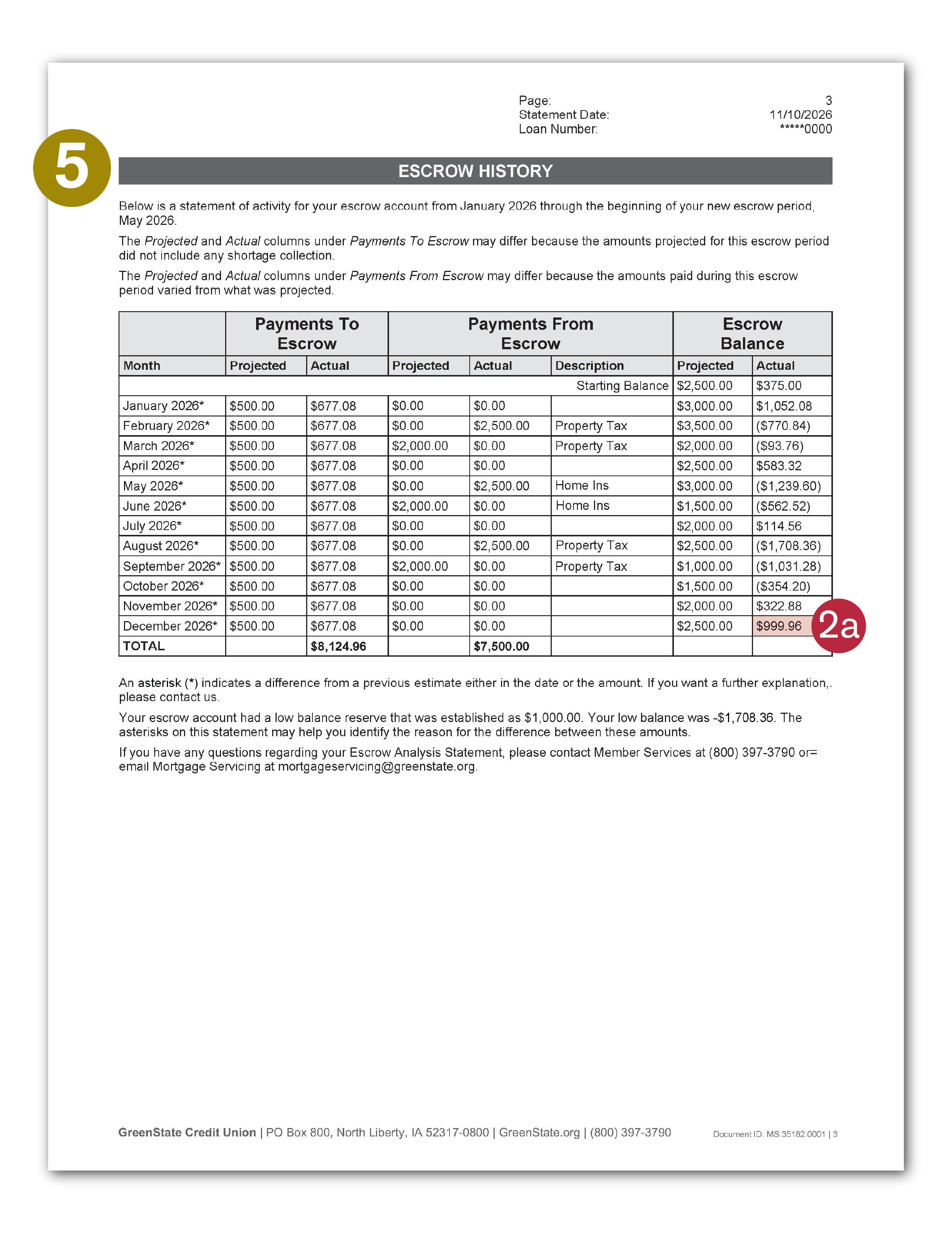
Page three details the Escrow History (5) and compares what was originally projected for your escrow account with what actually happened over the past year.
Escrow Example Page 3 updated

Additional Escrow FAQ

An escrow payment is included in your monthly mortgage or home loan payment, which is deposited into your escrow account. GreenState uses those deposited funds to pay your property taxes and/or insurance on your behalf (these are referred to below as T&I or “Taxes & Insurance”). Government regulations are restrictive in how borrowers and mortgage servicers can utilize escrow accounts. Additional information can be found at www.consumerfinance.gov.

Each year, your property tax and insurance payments change. To account for those changes, GreenState is required to determine any necessary increases or decreases to your monthly payment to pay for taxes and insurance while maintaining the required escrow cushion balance. Additional information about escrow cushions can be found in the "What is an escrow cushion?" section below. GreenState is required to perform and send an escrow analysis letter, also called a Tax and Insurance Account Disclosure Statement, at least once each calendar year.

An escrow analysis determines what adjustments need to be made to your mortgage or home loan payment. GreenState will pay your T&I regardless of the amount of funds you have in escrow at any given period of time. This often leads to your escrow account going negative or falling below your required escrow cushion. To avoid this, your mortgage payment may need to increase to compensate for the increases in your T&I disbursements.

In contrast, your escrow account is not a savings account. GreenState is mandated to relinquish any excess funds in escrow back to you in the form of an escrow surplus refund. If you have a surplus, GreenState will deposit your refund into the GreenState savings account tied to your loan.

Here is an example of how your escrow payment is calculated:

  • Total yearly taxes = $5,000
  • Annual insurance premium = $2,500
  • Total payments to taxes ($5,000) + insurance ($2,500) from escrow = $7,500
  • $7,500 divided by 12 monthly mortgage payments = $625 per month

This calculation is referred to as an unadjusted escrow payment or the minimum escrow payment. This calculation does not include any potential shortage or deficiency payment.

On the first page of your escrow analysis, you will see a breakdown of your new payment and when that payment will begin. The first page will also indicate if you have a shortage or surplus and the amount of said shortage or surplus. 

On page two, you will see your projections for your escrow account. This will include your minimum escrow payment and projected balances. In determining the shortage on page 1, we project what your lowest balance would be should we only collect for your minimum escrow payment (total taxes + insurance divided by 12). The difference between that amount and the cushion (two minimum escrow payments) is your shortage, if applicable. 

Page three lists your historical activity of your escrow account. The biggest pieces to pay attention to here are the differences between what was projected to be paid for taxes and insurance versus what was actually paid. Those projections were based on the prior analysis.

Your escrow cushion is a reserve in your escrow account that helps cover unexpected increases in property taxes, homeowners insurance, or other escrowed expenses. Federal regulations limit the cushion to no more than 1/6 of your total annual projected escrow disbursements, or approximately two monthly escrow payments. We require your projected escrow balance to remain above the cushion throughout the year. If your balance is projected to fall below the cushion, an escrow shortage will occur.

An escrow shortage occurs when your account's balance falls below the required minimum cushion to cover projected T&I. Your total escrow shortage is calculated by taking the difference between your lowest "Anticipated Balance" and "Required Balance". If you have an escrow shortage, the escrow analysis will determine your monthly escrow shortage payment by dividing the full shortage by 12 monthly payments. This amount is added to the minimum escrow payment.

An escrow deficiency occurs when the escrow account balance is negative. Paying the deficiency restores the escrow account balance to $0.00. Paying the escrow shortage provides the funds needed to bring the projected escrow balance up to the required cushion. Neither the escrow deficiency nor the escrow shortage is required to be paid in a lump sum.

The primary reason for a shortage is an increase in property taxes and/or insurance bills. New tax assessments done each year by your local county assessors determine your property tax amounts. Your insurance carrier determines your new premium amount.

GreenState Mortgage has no say in how these amounts are determined, but we are obligated to pay these amounts from your escrow account. 

Often borrowers will change insurance mid-year, and we are billed for a second policy, which is paid from your escrow. If your escrow account does not receive the refund from your previous insurance company, your escrow account will have paid two insurance policies, which can also cause a shortage.

If you would rather pay your full escrow shortage amount prior to making your new mortgage payment, you have the option of doing so. We do not require you to pay your escrow shortage in a lump sum. Your escrow shortage is located on the first page in the "Escrow Analysis” identified as “Escrow Account Shortage (Total)”. If you would like to pay your escrow shortage:

  • Stop by any branch and make an escrow only payment – be sure to let the teller know you are making an escrow shortage payoff.
  • Mail a check to GREENSTATE CREDIT UNION PO BOX 800 NORTH LIBERTY, IA 52317 ATTN: MORTGAGE SERVICING. Please include “Escrow Shortage” in the memo line. If a check is written off an account by someone not on the mortgage, please include the property address or loan number on the check so we can apply the funds to the correct escrow account.

E-mail [email protected], and we will transfer the funds for you if the funds are coming from a GreenState account.

Upon receiving your full escrow shortage payment, GreenState will adjust your payment accordingly by removing the shortage payment from your new monthly mortgage payment.

Note: Paying your full escrow shortage payment will not return your payment to what it was before, as the minimum escrow payment also increases to cover the T&I increases that caused the shortage to occur.

Our Member Assistance Center is available to answer basic questions regarding your escrow analysis. They are available at (800) 397-3790. You can also contact GreenState Mortgage Servicing directly at [email protected]

If you have specific questions about why your payment has changed, we recommend contacting your county or insurance representative.

Pages within